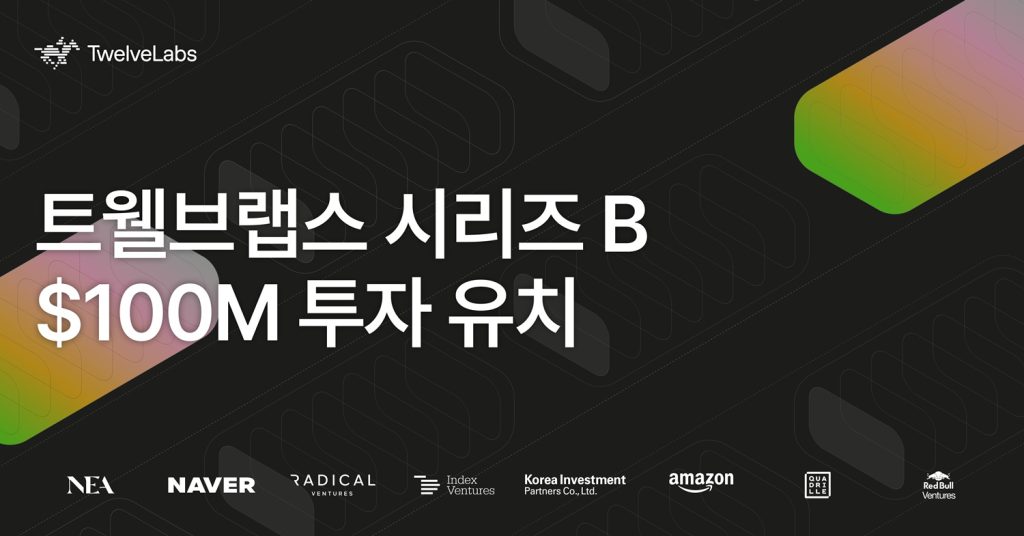
TwelveLabs, a South Korean-founded video AI company, has closed a Series B round of $100 million, co-led by NEA and Naver Ventures. The round pushes the company’s total funding raised to over $200 million.
The round was jointly led by global venture capital firm NEA and Naver Ventures, the venture arm of Korean tech giant Naver. Amazon joined as a major strategic investor. Existing investors Radical Ventures, Korea Investment Partners, and Index Ventures returned with follow-on investments, while Quadrille Capital and Red Bull Ventures came aboard as new backers. According to the company, many of these investors had backed TwelveLabs since its early days, when its core thesis was viewed skeptically by much of the AI industry, and returned to back the company again now that thesis is bearing out.
Founded five years ago by CEO and co-founder Jae Lee, TwelveLabs is a Korean-founded video AI company built on the belief that the world is composed of motion, not text — and that for AI to truly understand the physical world, it needs a representation of video that captures the medium itself, not just captions or metadata layered on top of it. The company has built what it calls a “Video Cognition System,” structured around three core capabilities: perception, memory, and reasoning.
On perception, TwelveLabs’ embedding model, Marengo, unifies visual, audio, spoken, and on-screen text information into a single, searchable representation, while its video-language model, Pegasus, turns that representation into video-grounded descriptions, answers, and summaries. On memory, rather than parsing video only when a query arrives, the system processes and encodes new video the moment it enters, converting it into a persistent representation that can pinpoint any scene in any file down to the second — turning video archives from passive storage into machine-readable memory. On reasoning, the system can search across, compare, and draw conclusions from evidence scattered across multiple points in time within video content — such as identifying what changed over a season, what preceded an equipment failure, or how coverage of an event evolved across hundreds of broadcasts.
The new capital will be used to further advance its Marengo and Pegasus models, deploy its Video Cognition System across some of the world’s most significant video archives, and recruit talent to help build AI systems grounded in the real world as captured on video. The company is positioning the investment as fuel for its next phase: moving beyond video understanding toward what it calls video superintelligence.