
Three of South Korea’s leading venture and startup associations jointly called on financial regulators to reconsider the proposed KOSDAQ restructuring, warning that the current reform plan fails to account for the unique nature of innovation-driven companies.
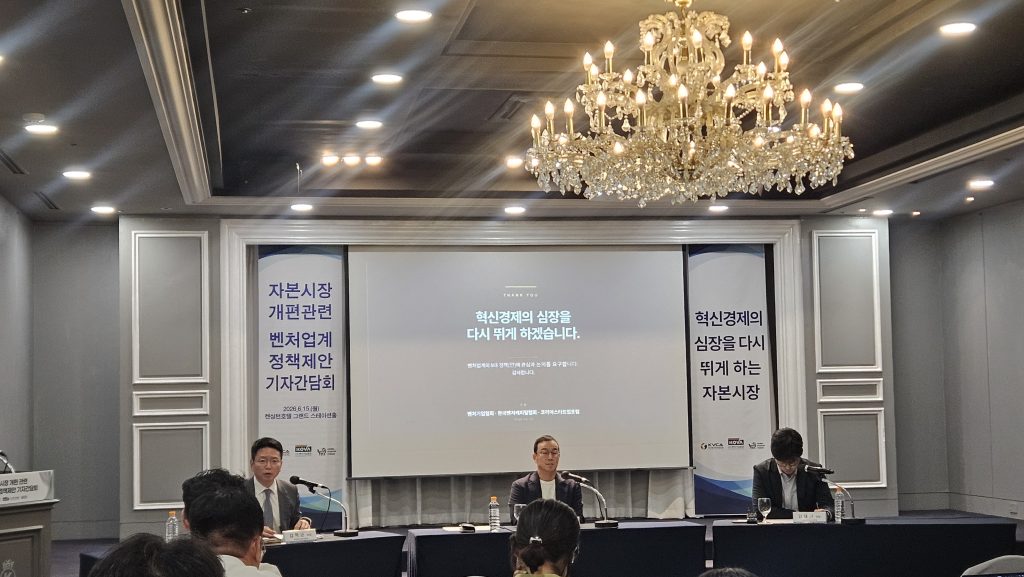
The Korea Venture Business Association (KOVA), the Korea Venture Capital Association (KVCA), and Korea Startup Forum (KSF) held a joint press conference on June 15 in Yeouido, Seoul, presenting five policy proposals to the financial authorities ahead of planned regulatory revisions.
Venture-backed companies account for 79.5% of all KOSDAQ-listed firms and represent 81.1% of the market’s total capitalization — making the venture sector the backbone of KOSDAQ. Yet the associations argued that the proposed reforms were designed with traditional financial metrics in mind, leaving out the realities of high-growth, pre-profit technology companies.
- Scrap the KOSDAQ Two-Tier Market Plan
The most contentious proposal involves the government’s plan to split KOSDAQ into a “Premium” and “Standard” segment. The three associations called for a full withdrawal and reconsideration of this segmentation scheme.
Their core concern is that deep-tech and biotech companies — which require long development timelines before generating profits — would be pushed into the lower-tier market regardless of their technological merit. Japan’s experience with the Tokyo Stock Exchange’s 2022 restructuring showed that institutional investor attention quickly concentrated in the top tier, with participation rates dropping sharply in lower segments. Given that institutional investors already account for only 7% of KOSDAQ trading, the associations warned that a two-tier system would worsen the liquidity gap for smaller innovative companies.
- Carve Out Venture Exemptions from Dual-Listing Restrictions
Regulators have been moving to restrict dual listings — where a subsidiary lists separately from its already-listed parent — citing concerns about large conglomerates extracting value from minority shareholders. The associations argued that this rule should not apply to venture companies.
When a venture firm acquires an external company as part of a new business strategy and later lists that entity, it is a fundamentally different situation from a chaebol spinning off a core unit for financial gain. The associations requested that regulators distinguish between the two cases by evaluating whether controlling shareholders stand to benefit unfairly and whether adequate protections are in place for general shareholders.
- Delay the KRW 30 Billion Market Cap Delisting Threshold
Starting January 2027, companies with a market capitalization below KRW 30 billion (approximately USD 22 million) will face delisting. The associations warned that this blunt quantitative rule could create a self-fulfilling downward spiral — where the threat of delisting suppresses stock prices, which in turn triggers the delisting condition.
They proposed either delaying enforcement or introducing a composite evaluation framework for venture companies that incorporates revenue growth trajectory and technology development milestones alongside market cap figures.
- Establish a Standing Policy Consultative Body
The associations emphasized that capital market reforms directly affect every stage of the venture lifecycle — from fundraising and investor relations to IPO strategy and exit markets. They argued that industry stakeholders must be included in the policy design process from the outset, not consulted after decisions have already been made.
The three groups formally requested the creation of a permanent consultative body that brings together financial regulators, the Korea Exchange, the Ministry of SMEs and Startups, and venture industry representatives to institutionalize advance input and impact assessments before major policy changes are enacted.
- Reform the Tech-Exception Listing System
South Korea’s technology-exception IPO pathway allows companies without profits to list based on technology evaluations — a critical route for deep-tech and biotech startups. The associations acknowledged the need for stronger investor protection but warned against tightening the criteria in ways that could effectively shut the door on early-stage innovators.
They proposed standardizing evaluation criteria across assessors, establishing sector-specific guidelines, and defining a uniform scope for due diligence — balancing investor protection with the continued availability of capital market access for technology-driven companies that are not yet profitable.